uvex_downlink_orientation#
- m4opt.missions.uvex_downlink_orientation(time)[source] [edit on github]#
Get the target coordinates and roll for a UVEX downlink.
For UVEX, calculate the telescope boresight target coordinate and the roll angle of the satellite for a ground contact. This is the orientation that points the high gain antenna toward the Earth while maintaining pointing constraints.
- Parameters:
time (Time) – Time of the downlink.
- Returns:
Target coordinate and roll angle.
- Return type:
Notes
UVEX’s high gain antenna is at a 45° angle to the spacecraft axes, and points toward the cool side and opposite the telescope boresight. In terms of the unit vector of the axes of the spacecraft coordinate system shown in the illustration for the
nominal_roll()method, the direction \(\hat{\mathbf{a}}\) of the antenna is:\[\hat{\mathbf{a}} = -\frac{\sqrt{2}}{2} \hat{\mathbf{x}} + \frac{\sqrt{2}}{2} \hat{\mathbf{z}}.\]For a ground contact, the following conditions should be met, as shown in the diagram below:
Solar array drive axis is perpendicular to the direction of the Sun and the Earth
Earth is 135° from the telescope boresight
Sun is ≥45° from the telescope boresight
The example below shows that all of these constraints are met for downlinks at any time over the course of a year.
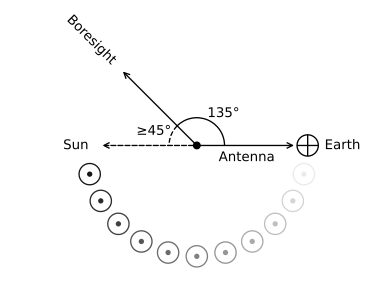
Orientation of the UVEX spacecraft for a downlink.#
import numpy as np
from astropy import units as u
from astropy.coordinates import (
    SkyCoord,
    CartesianRepresentation,
    get_body,
)
from astropy.time import Time
from m4opt.missions import uvex as mission, uvex_downlink_orientation
from matplotlib import pyplot as plt

time = Time("2025-01-01") + np.linspace(0, 1, 1000) * u.year
target, roll = uvex_downlink_orientation(time)

observer_location = mission.observer_location(time)
sun = get_body("sun", time, observer_location)
earth = get_body("earth", time, observer_location)
spacecraft_frame = target.skyoffset_frame(roll)
antenna = SkyCoord(
    CartesianRepresentation(-1 / np.sqrt(2), 0, 1 / np.sqrt(2)), frame=spacecraft_frame
)
solar_array = SkyCoord(CartesianRepresentation(0, 1, 0), frame=spacecraft_frame)

fig = plt.figure()
ax = fig.add_subplot()
ax.yaxis.set_major_locator(plt.MultipleLocator(45))
ax.yaxis.set_major_formatter(plt.FormatStrFormatter("%g°"))
dt = time.datetime
ax.plot(dt, target.separation(earth), label=r"Target $\leftrightarrow$ Earth")
ax.plot(dt, target.separation(sun), label=r"Target $\leftrightarrow$ Sun")
ax.plot(dt, solar_array.separation(sun), label=r"Solar axis $\leftrightarrow$ Sun")
ax.plot(dt, antenna.separation(earth), label=r"Target $\leftrightarrow$ antenna")
ax.legend(title="Separation", loc="center right", bbox_to_anchor=(0.975, 0.25))
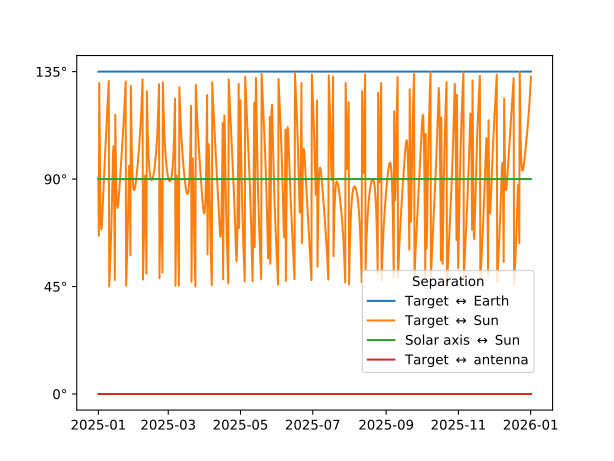
Satisfaction of downlink constraints as a function of time.#